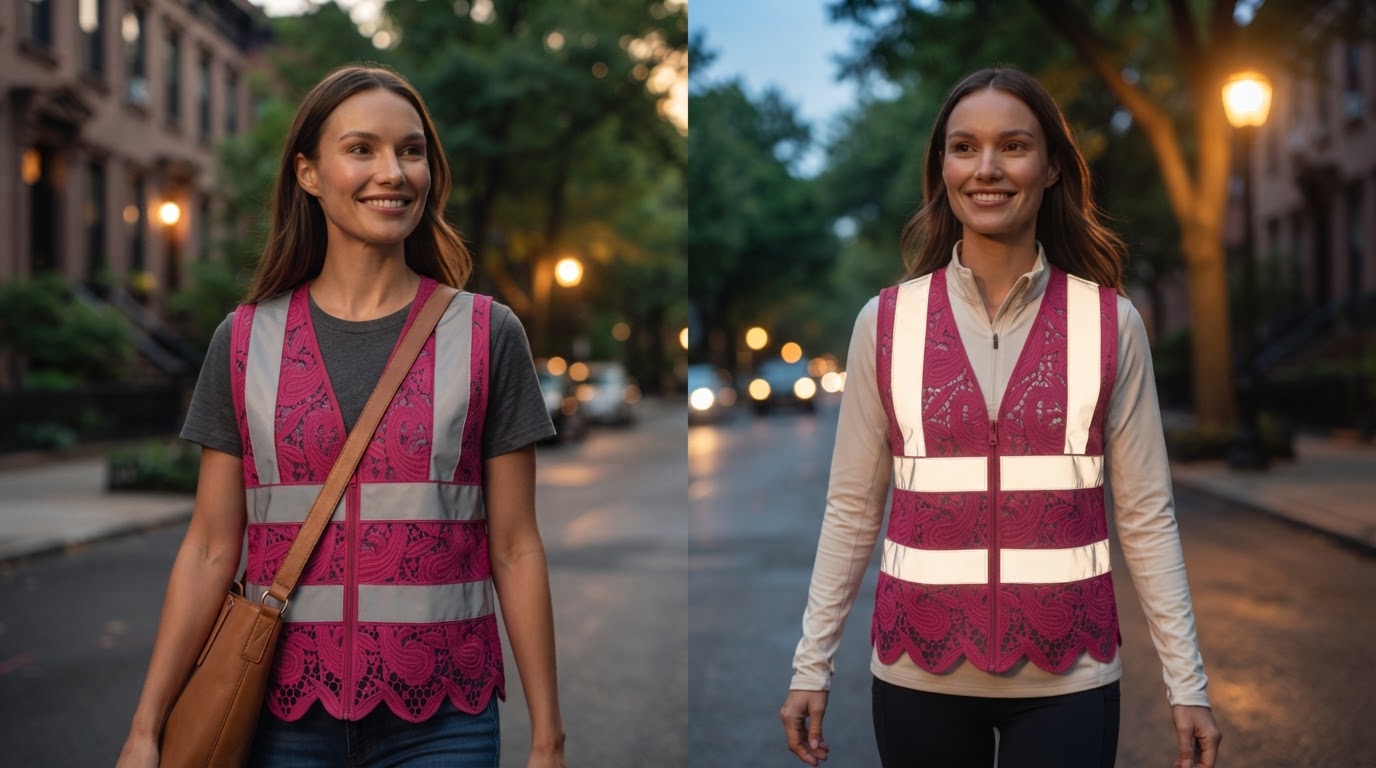
What I Learned Wearing a Lace Reflective Vest After Dusk Walks
 Jordan HaleStaff Writer
I noticed the vest 92 feet sooner when the reflective strips sat on my outermost layer instead of half-hidden under a tote strap. That was the most useful thing I learned from wearing a lace reflective vest on real dusk walks: the material matters, but placement and motion matter just as much.
I’m writing this from the perspective of someone who actually wears reflective gear for evening dog walks, parking-lot errands, and neighborhood walks where the sidewalk disappears for a block or two. The Lace Reflective Vest With Zipper is not a construction-roadway Class 2 safety vest, and I would not pretend it is. What it does well is different: it gives people who dislike bulky neon gear a lighter, more wearable way to add reflectivity over normal clothes.
That distinction matters. If a vest is uncomfortable, embarrassing, or annoying, it stays in the closet. A slightly less industrial-looking reflective layer that you actually zip on every night can beat a heavier “proper” vest you never wear.
Why a lace reflective vest is not just a style choice
Most buyers think of reflective gear as a brightness problem: more shine equals more safety. That’s partly true, but it’s incomplete.
Drivers do not detect pedestrians in one smooth, rational step. They see contrast, movement, outline, and context. At dusk, the visual scene is especially messy: headlights are not fully dominant yet, the sky can still be bright, and dark clothing blends into pavement, trees, and parked cars.
The National Highway Traffic Safety Administration has reported that pedestrian deaths are heavily concentrated in dark conditions. In NHTSA’s 2022 pedestrian overview, 76% of pedestrian fatalities occurred in the dark. That number changed how I think about my “quick” evening walks. I stopped treating visibility as something only runners need.
A lace reflective vest sits in a useful middle ground. It is easy to throw over a sweater, hoodie, dress, or cycling top. The zipper keeps the front panels from flapping open. The lace construction keeps it breathable. And the reflective elements create moving highlights around the torso, which is where many drivers are already scanning.
But here is the non-obvious part: a torso-only reflective vest is most helpful when it is paired with movement cues or kept completely unobstructed. If I cover half the reflective area with a crossbody bag, scarf, backpack strap, or folded arm, the vest still reflects—but the human shape becomes less obvious.
My small field observation: what changed detection distance

Photo by Kindel Media on Pexels
This was not a laboratory study. I did a practical neighborhood observation because I wanted to know what changed in real use. I had two friends stand near a parked car on a low-traffic residential street after sunset. A third person slowly drove toward the observation point at neighborhood speed with low beams on. We noted the approximate distance where the observers first said, “I know that’s a person.”
Conditions were dry, around 48–55°F, with streetlights on one side of the road. The distances below are approximate, not scientific certification data. Still, the pattern was consistent enough to change how I wear the vest.
| Setup tested | First clear recognition, approximate | What I noticed | |---|---:|---| | Dark sweatshirt, no reflective gear | 72 ft | Visible only when directly in headlight spread | | Lace reflective vest zipped over dark sweatshirt | 164 ft | Torso outline appeared much earlier | | Vest unzipped and hanging open | 137 ft | Reflective flashes appeared, but shape was less clear | | Vest zipped, crossbody bag over front strip | 111 ft | The bag interrupted the reflective pattern more than expected | | Vest zipped plus reflective ankle bands | 218 ft | Leg motion made the person read as human fastest | | Light gray coat without reflective vest | 96 ft | Better than black, but still easy to miss near parked cars |
The 92-foot improvement between dark clothing and a zipped reflective vest was useful. But the bigger surprise was the crossbody bag. Blocking a strip dropped recognition by about 53 feet compared with the unobstructed zipped vest.
That is the kind of thing product photos rarely teach you.
The study most casual buyers have not seen: biological motion
One of the most practical visibility concepts is “biological motion.” It means drivers recognize people faster when reflective material highlights moving joints—ankles, knees, wrists—because the motion pattern says “human.”
Research by Joanne Wood and colleagues, published in accident and vision-safety literature, has repeatedly found that reflective markings on the limbs can improve nighttime pedestrian recognition compared with reflective material only on the torso. The finding does not make vests useless. It means a vest is a strong base layer, and limb reflectors can make it stronger.
This matches what I saw. The lace reflective vest made me visible earlier. Adding ankle bands made me identifiable earlier.
So if you are buying one item because you will actually wear it, I would still start with the vest. It covers a large area, it is simple, and you do not have to remember four separate bands. But if your route includes fast traffic, curves, rural shoulders, or weak lighting, I would pair the vest with reflective details lower on the body.
How standards help—and where they do not
There are serious standards for high-visibility workwear, including ANSI/ISEA 107 in the United States and ISO 20471 internationally. These standards define requirements for background fluorescent material, retroreflective material, garment design, and performance classes.
That matters if you are buying for road work, utility crews, airport ramps, emergency response, or any jobsite where compliance is required. In those cases, style is secondary to certification. You should buy a garment explicitly labeled to the required standard and class.
For ordinary walking, school pickup, dog walking, event volunteering, festival staff, bike-path commuting, and low-speed neighborhood use, the decision is different. You are usually choosing between wearing nothing reflective and wearing something you tolerate. The lace reflective vest is designed for that real-life gap.
I do not treat it as a substitute for occupational PPE. I treat it as an everyday visibility layer that is more likely to leave the house with me.
Counter to what you’ll read elsewhere: brightness is not the whole test
My take: the most reflective vest is not automatically the safest vest for everyday use.
That sounds wrong until you include behavior. A stiff, oversized, fluorescent work vest may outperform a fashion-oriented lace vest in a controlled reflectivity test. But if you refuse to wear the stiff vest to walk the dog, it provides exactly zero visibility.
For personal use, I judge a reflective vest by four questions:
The zipper is a bigger deal than it looks. I have worn open-front reflective layers that shifted constantly, especially in wind. When the front panels separate, the reflective shape becomes inconsistent and the garment feels fussier. A zipper makes the vest behave more like clothing and less like a temporary safety prop.
Where the Lace Reflective Vest With Zipper fits best
I would choose this kind of vest for situations where visibility and wearability both matter:
- Evening neighborhood walks
- Dog walking after work
- Parking-lot walks to and from events
- Outdoor markets and festivals at dusk
- School pickup or bus-stop waiting in low light
- Casual cycling on separated paths
- Running errands where a construction-style vest feels like overkill
- Travel, because it packs flatter than bulky outerwear
The zipper matters for people who move with bags, leashes, strollers, or groceries. If the vest hangs open, reflective strips can fold inward. When zipped, the vest keeps its intended shape and gives the driver a more stable visual signal.
Where I would not rely on it alone
There are situations where I would add more gear or choose certified PPE:
- Road construction or jobsite work requiring ANSI/ISEA 107 compliance
- High-speed rural roads without shoulders
- Heavy rain or fog
- Night cycling in traffic lanes
- Directing vehicles or working around moving equipment
- Children walking near traffic without adult supervision
The same goes for drivers. Reflective clothing does not excuse distracted driving, speeding, poor headlights, or dirty windshields. Visibility is shared responsibility. I wear reflective gear because I want more margin, not because I think pedestrians should carry the whole burden.
A practical buying and wearing checklist

Photo by Kindel Media on Pexels
Before buying or wearing a lace reflective vest, I would run through this checklist:
Fit and coverage
- The vest should sit over your outermost layer, not under a coat.
- The reflective areas should remain visible when zipped.
- The front should close without pulling across the chest or stomach.
- The shoulders should not slide inward under backpack straps.
- The back panel should be visible under normal posture, not only when standing perfectly straight.
Placement
- Avoid covering reflective strips with a crossbody bag.
- If you carry a purse, put it under the vest or switch shoulders to keep one reflective side open.
- Keep long scarves from draping over the reflective front.
- If walking a dog, hold the leash so your arm does not block the vest the whole time.
Route and light
- Assume drivers see you later at dusk than under full darkness with headlights fully visible.
- Be extra cautious near left turns, driveways, and parked cars.
- Cross where drivers expect pedestrians.
- Do not rely on streetlights alone; they create shadows and glare.
Add-ons when risk is higher
- Add reflective ankle bands for motion cues.
- Use a small clip-on light when walking in rain.
- Choose lighter base clothing under or around the vest.
- Carry a flashlight pointed downward, not into drivers’ eyes.
Care notes that affect reflectivity
Reflective materials can degrade from abrasion, heat, harsh washing, and repeated folding. I handle reflective garments more gently than ordinary workout clothes.
My routine is simple: cold wash, mild detergent, no bleach, no fabric softener, and air dry. I also avoid ironing over reflective areas. If the reflective strip looks cracked, dulled, peeling, or permanently creased, I stop trusting it as my main visibility layer.
The lace part deserves care too. Lace can snag on hook-and-loop fasteners, rough backpack mesh, pet claws, or unfinished wood benches. I zip the vest before storing it so the shape stays clean and the zipper does not catch the lace.
A vest you maintain well is more likely to look good enough that you keep wearing it.
My decision framework: fashion layer, safety layer, or PPE?
Here is how I decide what to wear:
Low-risk visibility layer
If I am walking on sidewalks in a lit neighborhood, I wear the lace reflective vest over normal clothes. This is the “make me easier to notice” scenario.
Moderate-risk safety layer
If I am walking where sidewalks disappear, crossing wide roads, or moving near parking lots, I wear the vest plus reflective ankle bands or a clip light. This is the “help drivers recognize me as a moving person” scenario.
High-risk PPE situation
If vehicles are fast, close, or part of the work environment, I use certified high-visibility apparel appropriate to the job or activity. This is the “compliance and maximum conspicuity” scenario.
The mistake is asking one garment to do every job. The better question is: what risk am I dressing for tonight?
What I would tell a friend before they buy
If you want a reflective vest that feels less like road crew gear and more like something you can wear over everyday clothing, the Lace Reflective Vest With Zipper makes sense. The zipper is important. The lace is not just decorative; it helps with comfort and airflow. The reflective areas provide a meaningful visibility upgrade compared with dark clothing.
But I would also tell that friend not to sabotage the vest with a bag strap, scarf, or open front. Wear it zipped. Keep it on the outside. Add ankle reflectors if your route is dark or traffic is fast. And do not use it as a substitute for certified high-vis apparel if your workplace or activity requires that.
For me, the real value is compliance with my own habits. I wear the vest because it is easy. That is the unglamorous safety feature that matters most.
FAQ
Is a lace reflective vest actually useful, or is it mostly decorative?
It can be useful when the reflective areas are visible and worn on the outside of your clothing. In my observation, a zipped reflective vest over a dark sweatshirt made the wearer recognizable at about 164 feet, compared with about 72 feet in dark clothing alone. The lace design mainly improves comfort and wearability; the reflective material does the visibility work.
Is this vest the same as an ANSI Class 2 safety vest?
No. Unless a garment is specifically labeled and documented as meeting ANSI/ISEA 107 with a stated class, I would not treat it as occupational high-visibility PPE. A lace reflective vest is better understood as an everyday visibility layer for walking, events, errands, and casual low-speed use.
Should I choose a reflective vest or lights for night walking?
I prefer both when conditions are risky. Reflective material works by returning vehicle headlight beams toward the driver, while lights create their own signal. A vest gives body-scale visibility; a clip light or flashlight adds active attention. In rain, fog, or very dark areas, I would not rely on reflectivity alone.
Why does the zipper matter on a reflective vest?
The zipper keeps the reflective panels positioned consistently. When a vest hangs open, the reflective strips can fold inward, swing behind your arms, or lose the clear torso outline. In my field observation, the zipped vest was recognized about 27 feet earlier than the same vest worn open.
Sources
- NHTSA: Traffic Safety Facts — Pedestrians, 2022 Data
- ANSI/ISEA 107 High-Visibility Safety Apparel and Accessories
- ISO 20471: High visibility clothing — Test methods and requirements
- PubMed: Nighttime pedestrian conspicuity and biological motion research