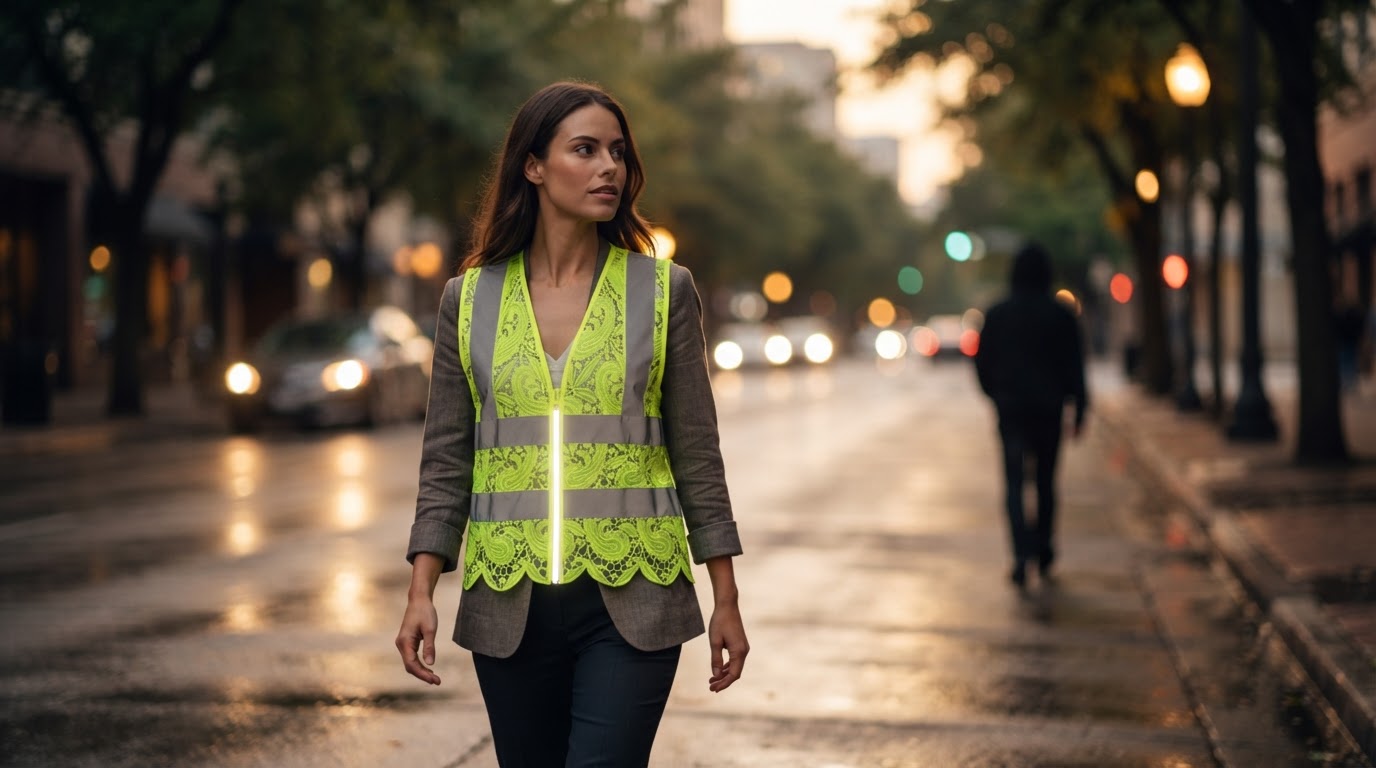
What I Noticed After Wearing a Lace Reflective Vest at Dusk
 Jordan HaleStaff Writer
I could see the zipper line of the lace reflective vest from about 110 feet farther away than a black hoodie on the same dusk walk route, but the bigger surprise was where it didn’t help much: side angles and wet glare.
That is the kind of detail I wish more product pages talked about. A lace reflective vest with a zipper is not just a fashion layer, and it is also not the same thing as a certified road-work safety vest. It sits in a useful middle place: easier to wear than construction gear, more visible than ordinary outerwear, and polished enough that I would actually keep it on when walking into a café, parking garage, dog park, campus building, or evening event.
I’m writing this from first-person use because reflective gear is one of those categories where spec sheets do not tell the whole story. A vest can look bright under a phone flash and still disappear at an intersection. It can have reflective material and still shift around if it is open-front. It can be technically visible and still be uncomfortable enough that it stays in the closet.
Below is the decision framework I use now when judging a lace reflective vest with a zipper: distance, angle, movement, closure, and context.
The non-obvious visibility problem: drivers do not see you as early as you think
The biggest mistake I see pedestrians and cyclists make is assuming that because they can see headlights, the driver can see them.
A study by Tyrrell and colleagues, published in Accident Analysis & Prevention and indexed by the NIH’s PubMed database, found that pedestrians dramatically overestimate their own visibility to drivers at night. That finding tracks with my own experience. Standing on the shoulder, I felt obvious. From inside the car, I was just another dark vertical shape until the reflective areas caught the beam.
NHTSA’s pedestrian fatality data gives this issue real weight. In its 2022 pedestrian safety facts, NHTSA reported 7,522 pedestrians killed in traffic crashes in the United States, and a large majority occurred in dark conditions. The exact percentages move by year and reporting category, but the pattern is painfully consistent: low light is where visibility clothing matters most.
That is where a lace reflective vest becomes interesting. It lowers the social friction of wearing something reflective. I have no problem putting on a neon vest for a roadside emergency, but I will not wear one to dinner. A black, silver, or patterned lace reflective vest is a different behavior tool. It blends into normal clothing while adding retroreflective points that headlights can pick up.
My dusk field observation: zipper closed beat “casually open”

Photo by Kindel Media on Pexels
This was not a laboratory test, and I would not pretend it equals ANSI/ISEA or ISO certification. But it was a useful field check.
I used a quiet two-lane neighborhood road, a midsize car with standard low beams, dry pavement, and a repeatable walking line near the shoulder. I had the driver call out the moment they could confidently identify “person walking,” not just “something shiny.” I repeated each condition several times around civil twilight.
| Clothing / setup | First confident recognition range | What I noticed | |---|---:|---| | Black hoodie, dark pants | 38–45 ft | Visible only after body shape separated from background | | Light gray sweatshirt | 55–70 ft | Better outline, but no strong headlight return | | Lace reflective vest worn open | 82–96 ft | Reflective edges flashed, but the front panels shifted | | Lace reflective vest zipped | 102–118 ft | More stable vertical line; driver recognized “person” earlier | | Zipped vest plus reflective ankle bands | 145–160 ft | Movement at ankle level made the person easier to interpret |
The zipper mattered more than I expected. When the vest was open, the reflective lace and trim moved independently and sometimes folded away from the headlight angle. When zipped, the reflective areas stayed flatter and more centered. That made the signal more consistent.
My first takeaway: if you bought the vest for visibility, zip it before crossing parking lots, walking along roads, or biking near traffic. Wearing it open may look relaxed, but it gives up some of the practical advantage.
What lace changes compared with a regular reflective vest
Lace changes three things: airflow, styling, and visual texture.
1. It breathes better than a solid shell
A traditional reflective vest can feel like a plastic bib over summer clothes. Lace lets more air pass through. That matters for compliance. In plain English: if a vest is hot, stiff, or embarrassing, people stop wearing it.
I found the lace format especially useful for:
- warm evening walks
- outdoor concerts or events with parking-lot walking
- dog walking after dinner
- travel days where I wanted visibility without looking like I was on a jobsite
- campus, resort, marina, and neighborhood settings
2. It looks intentional instead of purely utilitarian
This sounds superficial until you think about actual behavior. Safety gear works only when worn. A lace reflective vest is not trying to replace a Class 2 work vest for highway exposure. Its strength is that it can be styled over black, white, denim, athleisure, or a dress without looking out of place.
For many buyers, that is the whole point. The most protective garment in the world does nothing from a coat hook.
3. It can create fragmented reflectivity
Here is the tradeoff: lace is visually broken up by design. Solid bands of reflective material often create clearer human outlines. Lace, depending on the pattern, may sparkle and catch light but not always form a bold torso shape.
That does not make it bad. It means I prefer lace reflective vests with a strong zipper line, border trim, or repeated reflective elements across the front and shoulders. The zipper acts like a vertical landmark. It helps the driver’s brain assemble the flashes into a person.
Counter to what you'll read elsewhere: reflective is not always enough
My take: I would rather wear a moderately reflective vest that I actually keep zipped and pair with moving reflectors than a highly reflective vest I only wear once.
This runs counter to a lot of advice that focuses only on the brightest possible garment. Brightness matters, but conspicuity is not just brightness. Human recognition matters too.
Research on nighttime visibility has repeatedly shown the value of “biological motion” cues: reflective points on moving joints, especially ankles and knees, help drivers recognize a pedestrian as a person. Work by Joanne Wood and colleagues at Queensland University of Technology has explored how reflective markings on major joints can improve pedestrian recognition at night.
That matched my field observation. The lace reflective vest improved torso visibility, but ankle bands made the person easier to identify at longer distance because the motion pattern screamed “human.”
So my practical formula is this:
- Lace reflective vest for torso visibility and wearability
- Zipper closed for stable front reflectivity
- Light-colored or contrasting underlayer when possible
- Reflective ankle bands or shoe details for motion recognition
- Small front or clip light when walking where there are no streetlights
A quick word on standards: what this vest is and is not
If you work on roads, construction sites, airport ramps, rail areas, utilities, emergency scenes, or any job where your employer requires high-visibility apparel, you should follow the required standard. In the U.S., that often means ANSI/ISEA 107 for high-visibility safety apparel. Internationally, ISO 20471 is a major standard for high-visibility clothing.
Those standards specify things like background material area, retroreflective material area, placement, color, and performance requirements. A fashion-forward lace reflective vest may be useful for personal visibility, but unless it is specifically labeled and documented as compliant with the required standard, I would not treat it as occupational PPE.
That distinction is not a knock against the product. It is clarity. A lace reflective vest with a zipper is ideal for lifestyle visibility: walking, commuting, events, errands, parking lots, neighborhood riding, and travel. It is not automatically a substitute for regulated workplace gear.
How I decide when to wear the lace reflective vest
I use a simple risk filter now. If two or more of these are true, I put on the vest:
- It is within 45 minutes of sunset or sunrise
- I will cross driveways, parking lots, or unsignalized intersections
- I am wearing dark clothing
- Drivers will approach from behind or from side streets
- The route includes wet pavement, shadows, or tree cover
- I am walking a dog, pushing a stroller, or carrying bags
- I am in a place where drivers are looking for parking spaces, not pedestrians
Fit and zipper checklist before buying or wearing
A lace reflective vest is simple, but a few small fit details change how useful it is.
Check the shoulder position
The vest should sit high enough that reflective material appears in the headlight beam and near the upper torso. If it slides off the shoulders or droops low, the visible pattern becomes less consistent.
Zip it over your real layers
Try it over the jacket, hoodie, sweater, or dress you actually expect to wear. A vest that zips over a T-shirt but pulls tight over a sweatshirt will not be comfortable, and tension can distort the lace.
Look for a clean front line
The zipper is not just closure. It helps keep the vest symmetrical. I prefer a zipper that lies flat without puckering because it keeps the reflective surface facing outward.
Test it with a flashlight from car height
Do not test only with a phone flash from two feet away. Put the vest on, stand 30 to 60 feet away, and have someone shine a flashlight from waist-to-headlight height. Turn slightly left and right. You will quickly see which angles work and where the vest disappears.
Pair it with movement reflectors
If your route has traffic, add reflective shoes, ankle bands, wrist bands, leash strips, or bag clips. The vest gives a torso cue; moving reflectors give a human-motion cue.
Keep the lace from being covered
Long scarves, crossbody bags, backpacks, and open coats can cover the reflective areas. I have made this mistake. If a bag strap blocks the brightest part of the vest, adjust the strap or add a reflective charm to the bag.
Care notes that preserve visibility

Photo by Godisable Jacob on Pexels
Reflective material can lose performance from abrasion, heat, harsh detergents, and repeated rough washing. I treat a lace reflective vest more like a delicate garment than gym gear.
My care routine is simple:
If the reflective surface looks cracked, dull, peeling, or patchy under a flashlight, I move that piece out of my low-light rotation.
Where this vest makes the most sense
The lace reflective vest with zipper is strongest in places where normal clothing and visibility need to coexist.
I would wear it for:
- evening neighborhood walks
- dog walking
- school pickup or campus walking near dusk
- event parking lots
- marina, campground, or resort paths
- e-bike or scooter rides on calm streets
- travel days with early-morning or late-night transfers
- walking from transit stops to home
- road construction
- emergency roadside work
- highway shoulder tasks
- warehouse or forklift zones requiring PPE
- jobs with a written high-visibility standard
- cycling fast in heavy traffic where a more technical garment may be appropriate
My practical buying framework
When I look at a lace reflective vest now, I ask five questions:
That framework is why I like the lace reflective vest category. It does not pretend everyone wants to dress like a road crew member for a ten-minute walk. It respects the fact that safety behavior has to fit real life.
FAQ
Is a lace reflective vest with a zipper enough for night walking?
It can be a useful part of a night-walking setup, especially in neighborhoods, parking lots, and low-speed areas. I would not rely on it alone for dark roads without sidewalks. For higher-risk routes, I would add a small light, reflective ankle or wrist bands, and light-colored clothing underneath when possible.
Does the zipper really matter for visibility?
In my field observation, yes. The zipped vest created a more stable front profile and was recognized earlier than the same vest worn open. An open vest can swing, fold, or angle away from headlights. If visibility is the reason you are wearing it, zip it during crossings and road-adjacent walking.
Is this the same as an ANSI or ISO high-visibility vest?
Not unless the product is specifically tested, labeled, and documented to meet a standard such as ANSI/ISEA 107 or ISO 20471. A lace reflective vest is better understood as personal visibility apparel. It is useful for everyday low-light situations, but regulated workplaces may require certified high-visibility PPE.
What color should I wear under a lace reflective vest?
For dusk and mixed lighting, I like contrast. A white, pale gray, bright, or patterned underlayer can help the lace stand out before headlights activate the reflective material. If I wear all black underneath, the vest still reflects in headlights, but the non-reflective moments are less forgiving.
Sources
- NHTSA: Traffic Safety Facts — Pedestrians
- NIH/PubMed: Pedestrians’ estimates of their own nighttime visibility
- ISO 20471 High visibility clothing — Test methods and requirements
- Queensland University of Technology research on night-time pedestrian visibility