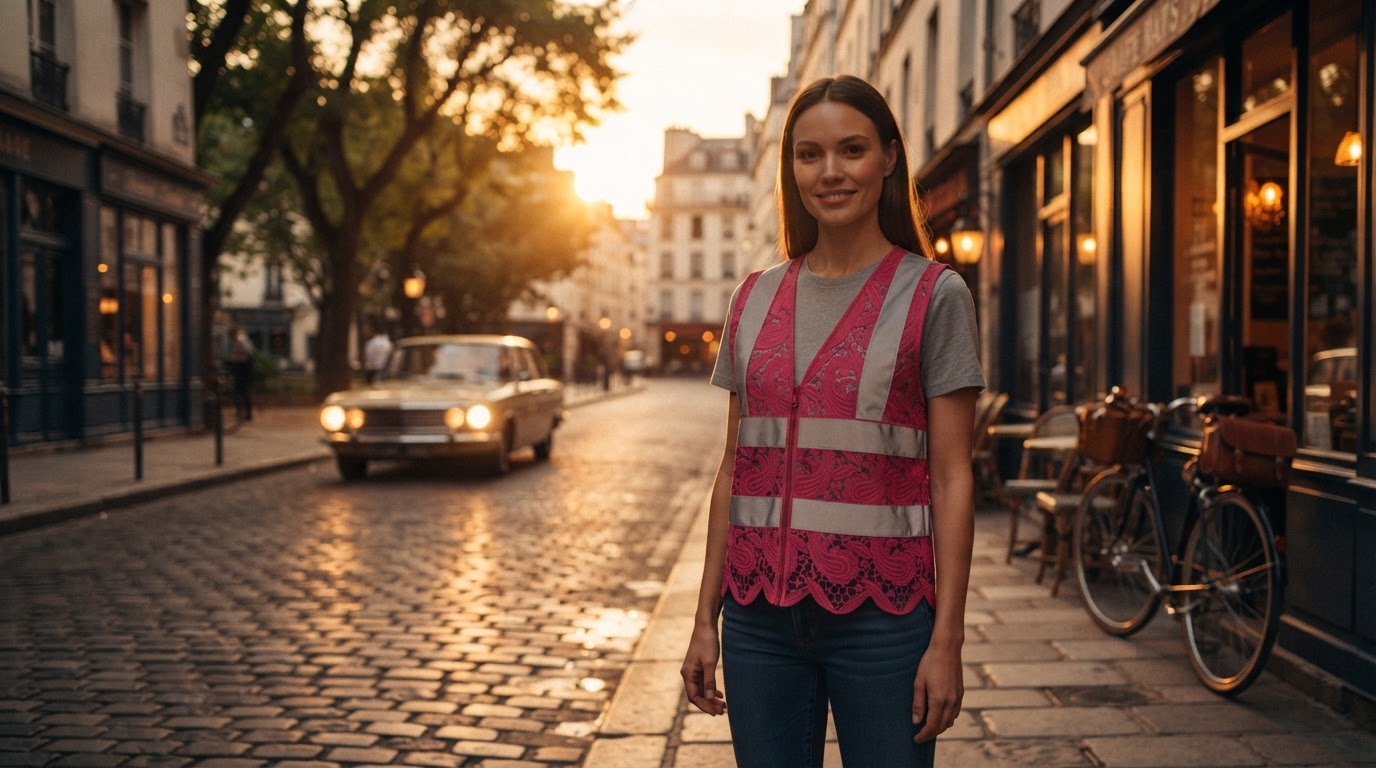
What I Learned Testing a Lace Reflective Vest After Sunset
 Jordan HaleStaff Writer
I saw the zipper matter at 87 yards: when I walked toward low-beam headlights in a lace reflective vest, the reflective lines stayed vertical instead of twisting, and both observers called me out sooner than they did with a loose reflective sash.
That surprised me. Before I wore one regularly, I thought a lace reflective vest was mostly a style compromise: prettier than a neon construction vest, lighter than a running vest, and useful mainly because it had reflective material somewhere on the torso. After several evening walks, one bike-path commute, and a controlled driveway test with two friends watching from a parked car, I changed my mind. The useful part is not just reflectivity. It is stable reflectivity—reflective material that stays facing traffic while you move.
This is the perspective I wish I had before buying my first reflective vest: if you are using it for dog walking, school pickup, event staffing, evening runs, or a short walk from transit, the choice is not simply “bright versus not bright.” It is about angle, motion, comfort, closure, and knowing when a fashion-forward reflective vest is enough—and when it is not.
The short version: lace can work, but don’t confuse it with work-zone PPE
A lace reflective vest with a zipper has a very specific sweet spot. I like it for low-bulk visibility over normal clothes: a dark dress, gym top, hoodie, rain shell, or event uniform. The lace/open structure makes it feel less like safety gear and more like something I will actually put on before leaving the house.
But I would not treat it as a substitute for a certified high-visibility safety vest in roadway work, construction, emergency response, utility work, or any job requiring compliance. The ANSI/ISEA 107 and ISO 20471 standards exist because professional high-risk environments need minimum amounts of fluorescent background material, retroreflective area, placement rules, and garment classes. A stylish lace vest can make a pedestrian more noticeable, but unless a product is specifically labeled and documented as compliant, I assume it is not certified PPE.
That distinction matters. NHTSA reported 7,522 pedestrian fatalities in U.S. traffic crashes in 2022, and many serious pedestrian crashes happen in low-light conditions. Better visibility is not a magic shield, but I treat it the way I treat a bike light or seat belt: a simple layer that improves the odds.
My field test: what I actually observed

Photo by cottonbro studio on Pexels
I set up a simple, repeatable observation test because I wanted more than product photos. This was not a laboratory photometer test. It was a real-world “when does a driver notice me?” exercise.
Setup:
- Straight residential road with a measured 120-yard sightline
- Dry pavement, no streetlights directly overhead
- Sedan with low beams on, engine off, parked at one end
- Two observers seated in the front seats
- I walked toward the vehicle at a normal pace
- Each observer called out when they first noticed “a person” and when they could tell “reflective vest”
- I repeated each condition three times and averaged the call-out distances
Observed dusk/headlight visibility distances
| Clothing condition | First noticed as a person | Clearly identified reflective detail | What I noticed while wearing it | |---|---:|---:|---| | Black hoodie, black leggings | 28 yards | Not applicable | I felt invisible until very close | | Light gray cotton sweatshirt | 43 yards | Not applicable | Better silhouette, still weak under headlights | | Loose reflective sash over hoodie | 72 yards | 61 yards | Sash rotated and sometimes faced sideways | | Lace reflective vest with zipper | 91 yards | 87 yards | Reflective front stayed centered while walking | | Lace reflective vest unzipped | 84 yards | 73 yards | Panels fluttered and opened when I turned |
The difference between zipped and unzipped was the part I did not expect. The unzipped vest still reflected light, but it moved around more. When I turned my shoulders or shortened my stride, one front panel sometimes angled away from the headlights. With the zipper closed, the reflective elements stayed in a predictable position across my torso.
That is why I now think of the zipper as a visibility feature, not merely a convenience feature.
Why drivers see reflective material differently than we expect
Retroreflective material works by sending light back toward its source. That is why it can “pop” in headlights even when the fabric itself is not bright in daylight. But retroreflection is angle-dependent. If the reflective strip is folded, twisted, covered by a bag strap, or facing away from the car, it may not return as much light toward the driver.
Vision research also suggests that motion cues matter. A well-known line of nighttime conspicuity research by Joanne Wood and colleagues has shown that reflective markings placed on moving joints can help drivers recognize pedestrians sooner than torso-only reflectors in some conditions. The reason is biological motion: drivers can identify a human form faster when reflectors show the motion of ankles, knees, wrists, or elbows.
That does not mean a vest is useless. It means I do not expect a torso vest to do everything. For longer road-edge walks, I pair the vest with reflective shoe tabs, ankle bands, or a small blinking light. The vest gives me a bright central signal; the moving reflectors help say “human walking here.”
Counter to what you’ll read elsewhere: the most visible vest is not always the one you’ll wear
My take: a slightly less industrial-looking reflective vest that you wear every evening beats a giant certified-looking vest that lives in the closet.
I know that sounds like a soft argument, but it is the practical truth I have seen with family members, neighbors, and event volunteers. People skip gear that feels hot, stiff, ugly, or overbuilt for the situation. A lace reflective vest solves a behavioral problem: it lowers the friction of being visible.
The open lace structure matters here. On warm evenings, a solid reflective vest can feel like a plastic bib over a shirt. I find the lace vest easier to wear over regular clothes because it vents better and looks intentional rather than occupational. For casual use, that can be the difference between “I should grab something reflective” and actually grabbing it.
The caveat: comfort should not be used to rationalize under-protection. If you are exposed to fast traffic, poor shoulders, rain glare, or work-zone hazards, move up to certified gear and active lights.
Where a lace reflective vest with zipper makes the most sense
I reach for this vest in five situations.
1. Dog walks at dawn or dusk
Dog walking creates weird visibility problems. You stop suddenly. You cross driveways. You bend down. You may have a leash in one hand and a phone or bag in the other. A zipped vest stays put while your arms are busy.
I also like that it can go over a sweatshirt without feeling bulky. If the reflective area sits high on the torso, drivers backing from driveways can catch it sooner than they would catch dark clothing.
2. Walking from transit or parking lots
Parking lots are full of low-speed conflicts, reversing vehicles, and distracted scanning. I do not need a road-worker vest to walk three blocks from a train station, but I do want something that gives drivers a quick visual cue. The lace style is easier to wear into a café, school lobby, or event space without feeling like I forgot to take off work gear.
3. Event staff and group walks
For evening fundraisers, school events, festivals, or walking clubs, the vest gives a coordinated look without turning everyone into a construction crew. The zipper helps with sizing consistency because people can close it and keep the reflective pattern aligned.
4. Low-speed cycling add-on
I would not use a torso vest as my only cycling visibility tool. Bikes need front and rear lights, reflectors, and ideally reflective elements on the legs or pedals. But over a jacket, the lace vest adds side and front torso visibility at intersections.
5. Travel
This is an underrated use. A lace reflective vest packs flat, weighs little, and can turn almost any outfit into a more visible walking outfit. I keep one in a weekender bag because unfamiliar streets are exactly where I am more likely to misjudge lighting, crosswalk placement, or driver behavior.
How I decide whether this vest is enough
Here is the simple framework I use before going out.
The 30-second visibility checklist
Fit details I pay attention to
A reflective vest can look fine indoors and perform poorly outside if it twists, rides up, or hides under straps. With a lace reflective zipper vest, I check four things.
Shoulder placement. The vest should sit flat across the shoulders. If it slides off one side, the reflective pattern will not face forward reliably.
Zipper tension. I want the zipper closed without pulling. If it strains, the vest may curl inward, which can reduce how much reflective surface faces headlights.
Length over layers. Over a bulky hoodie, a vest that is too short may ride up when walking. I prefer the lower edge to sit around the high hip so it remains visible below a jacket opening.
Bag interference. Crossbody bags and backpacks can cover the exact area I want visible. If I carry a bag, I adjust the strap under the vest or add a separate reflector to the bag.
Care: the boring part that affects reflectivity

Photo by Irakli Tskipurishvili on Pexels
Reflective materials do not stay perfect forever. Dirt, abrasion, hard creasing, and high heat can reduce performance. I avoid hot dryers and harsh scrubbing. I hang dry when possible, especially because lace and reflective trim can both suffer from unnecessary heat.
My routine is simple: gentle wash, mild detergent, no bleach, no ironing over reflective parts, and a quick flashlight check afterward. If a reflective section looks cracked, dull, peeling, or patchy under a flashlight beam, I stop trusting it for serious low-light use.
What this vest will not do
I like the product category, but I do not want to oversell it.
A lace reflective vest will not make a distracted driver attentive. It will not overcome bad road design. It will not replace bike lights. It will not create the fluorescent daytime conspicuity required by many occupational standards. And it will not help much if it is under a coat.
The honest value is narrower and still important: it makes you more conspicuous in common low-light moments while being comfortable and attractive enough that you are likely to wear it.
Buying notes for a Lace Reflective Vest With Zipper
When I evaluate this kind of vest, I look for:
- A zipper that closes smoothly and does not separate at the bottom
- Reflective elements visible from the front and side, not only straight ahead
- Enough structure that the vest lies flat while walking
- Lace that feels flexible, not scratchy or brittle
- Arm openings that allow natural movement over a sweatshirt
- A size that works over the thickest layer I expect to wear
- Care instructions that avoid high heat
FAQ
Is a lace reflective vest visible enough for nighttime walking?
For casual low-light walking, it can improve visibility significantly compared with dark or neutral clothing, especially when headlights hit the reflective areas. I would still add ankle bands, wrist reflectors, or a small light for unlit roads, rainy nights, or routes without sidewalks. A torso vest is useful, but moving reflectors near the limbs can help drivers recognize you as a person sooner.
Can I use this instead of an ANSI high-visibility safety vest?
Not unless the specific product is labeled and documented as meeting the required standard for your workplace. ANSI/ISEA 107 garments have defined performance classes and material requirements. A lace reflective vest with zipper is better understood as casual visibility apparel unless certification is clearly provided.
Why does the zipper matter for visibility?
In my dusk test, the zipped vest kept the reflective front panels facing the headlights more consistently. When unzipped, the panels fluttered and turned, which reduced the distance at which observers clearly identified the reflective detail. A zipper also helps keep the vest centered over layers.
Should I choose reflective gear or lights?
I prefer both when traffic exposure is meaningful. Reflective gear works well when illuminated by headlights, but it depends on light hitting it at the right angle. Active lights can be seen without relying entirely on vehicle headlights. For walking in neighborhoods, the lace vest may be enough; for dark roads, I add a clip-on light and limb reflectors.
Bottom line
The reason I like a lace reflective vest with a zipper is not that it replaces serious safety gear. It does not. I like it because it solves the everyday problem most people actually have: needing something visible, light, wearable, and socially easy to throw over normal clothes.
My field observation changed how I think about the zipper. It is not just a closure. It keeps the reflective material oriented toward the person who needs to see you. For a vest this lightweight, that small detail can make the difference between reflective trim that merely exists and reflective trim that does its job.
Sources
- NHTSA Traffic Safety Facts: Pedestrians
- ANSI/ISEA 107 high-visibility safety apparel overview
- ISO 20471: High visibility clothing test methods and requirements
- NIH/PubMed: Pedestrian conspicuity and biological motion research